The Colorado webcam guide
Denver
10 camera views · 1 stream embeds · Snapshots refresh every 60 seconds while visible.
Live streams
Click to load a provider's player. Pause or stop it when you're finished.
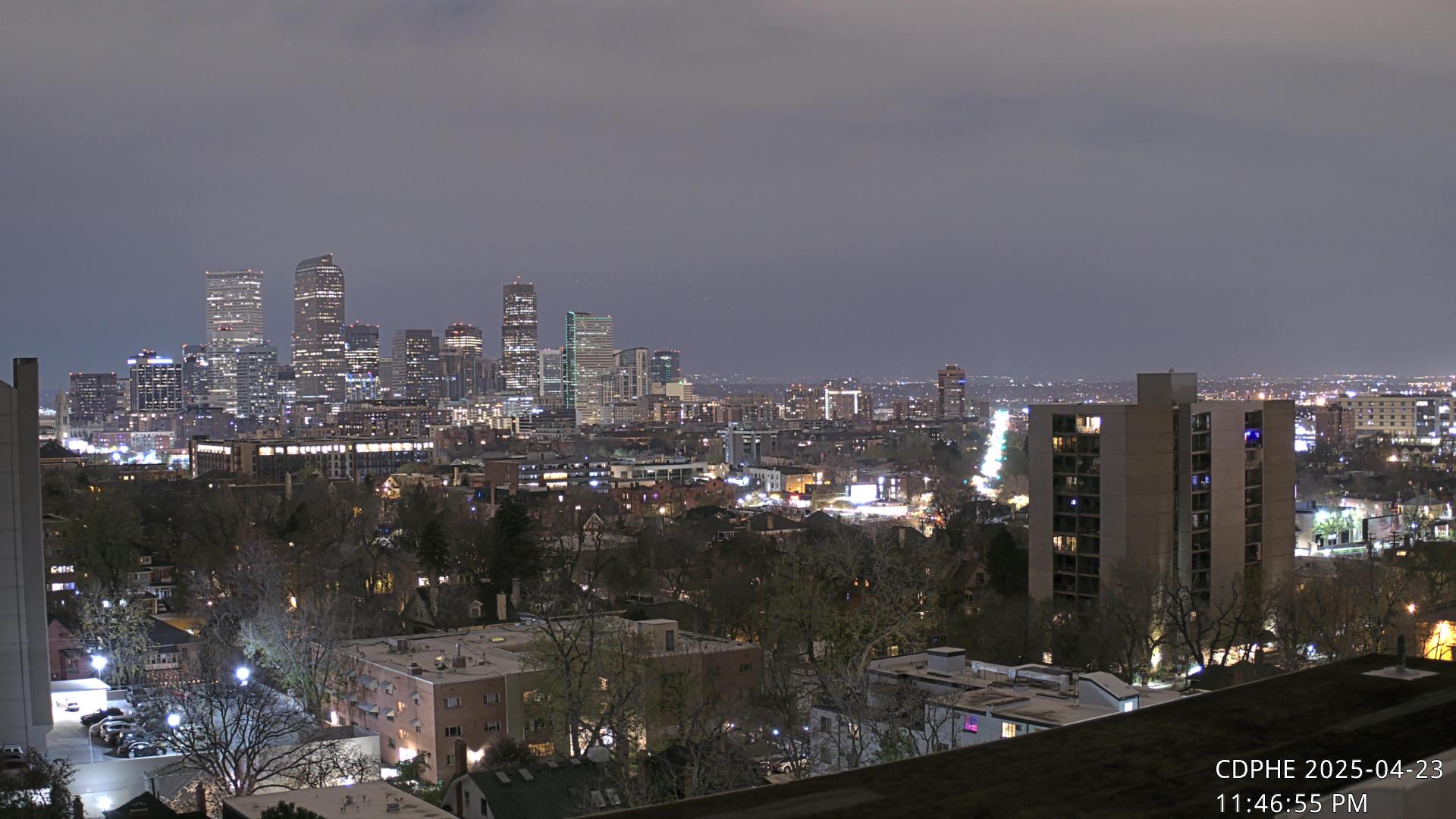 SnapshotChecking image…
Downtown Denver (From Colorado Department of Public Health and Environment
Source: apcd.state.co.us · URL repaired
 SnapshotChecking image…
 SnapshotChecking image…
 SnapshotChecking image…
View from the Denver Mousetrap (at I-25 & I-70) (From CBS Denver )
Source: static.cbslocal.com
 SnapshotChecking image…
 SnapshotChecking image…
 SnapshotChecking image…
 SnapshotChecking image…
 SnapshotChecking image…
 SnapshotChecking image…
Feed status reflects a migration-time image request, not a guarantee that the image is current. Check the image timestamp. Camera imagery © the credited provider.
About Denver
Denver is the capital and most populous municipality in the state of Colorado. It’s in the South Platte River Valley on the western edge of the High Plains just east of the Front Range of the Rocky Mountains, and approximately 12 miles (19 km) east of the foothills of the Rocky Mountains. Denver is nicknamed the Mile High City because its official elevation is exactly one mile (5,280 feet / 1,609.3 meters) above sea level, making it the highest major city in the United States. Its population was 715,522 at the 2020 United States census, a 19.2% increase since the 2010 census, Denver is the 19th-most populous U.S. city, and it was named the best place to live in the United States by U.S. News & World Report.
The city of Denver dates back to the Old West era. Larimer Square, the city’s oldest block, features landmark 19th-century buildings. Denver is also a jumping-off point for ski resorts in the nearby Rocky Mountains. It is a major cultural hub with many cultural institutions and museums include the Denver Art Museum, an ultramodern complex known for its collection of indigenous works, the Denver Museum of Nature and Science, Denver Botanic Gardens and the Denver Zoo. Denver also has professional sports teams in five leagues and hosts the headquarters of eight Fortune 500 firms.
Denver features a cool semi-arid climate with generally low humidity and around 3,100 hours of sunshine per year, although humid microclimates can be found nearby depending on location. It receives most of its precipitation from April through August. Due to its inland location on the High Great Plains, at the foot of the Rocky Mountains, the region is subject to sudden changes in weather. July is Denver’s warmest month, with an average high temperature of 89.9°F (32.2°C). High temperatures reach 90°F (32°C) on 38 days annually, and occasionally 100°F (38°C). Winters consist of periods of snow and very low temperatures alternating with periods of milder weather due to the warming effect of Chinook winds. Daytime highs in winter occasionally exceed 60°F (16°C), but they also often stay below 32°F (0°C) during periods of cold spells. Occasionally, daytime highs can fail to rise above 0°F (−18°C), due to arctic air masses. It’s all time record high temperature, 105°F (41°C), has been reached on 5 different dates! It’s coldest temperature was -29°F (-34°C), set on January 9, 1875, over 150 years ago! Since then, the next closest temperatures occurring in 1990, 1963, and 1876, were -25°F (-31.7°C). The average snowfall per season in Denver is between 49 inches (124 cm) and 57 inches (145 cm). The snowiest season on record was during the 1908–1909 season, with a total of 118.7 inches (301.5 cm).
Camera credits & local resources
Denver on the map
Location from the original Keno map embed; it marks the destination, not each camera.
Keep exploring
Original Keno page · Original descriptions © Keno Internet Services.